


The Retirement Tax Trap: Why Saving the “Right” Way Can Backfire
If you’ve saved well for retirement but haven’t planned for taxes after retirement, this is a conversation you don’t want to ignore.


Long term return potential driven by direct participation in company growth, operational improvement, and global innovation.

Designed to seek income generation through disciplined underwriting and a focus on senior positioning within the capital structure.

Stable cash flow and inflation sensitivity backed by tangible assets, long duration contracts, and essential services.

Institutional-caliber strategies focused on essential assets with predictable cash flows and long-term demand characteristics.
Adding alternative investments can enhance risk-adjusted returns by introducing sources of return that behave differently from traditional stocks and bonds. As illustrated below, incorporating private market strategies may increase a portfolio’s expected return while maintaining or, in some cases, reducing expected volatility. Volatility is commonly used as a measure of portfolio risk.
Annualized volatility and returns, 1989–2022***
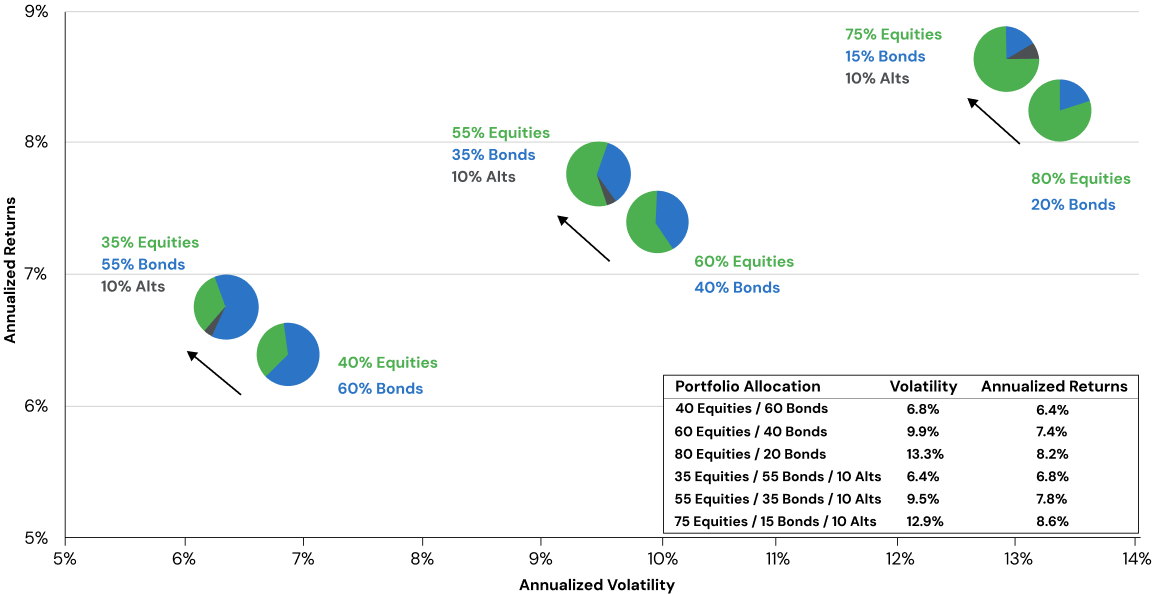
Source: Bloomberg, Burgiss, HFRI, NCREIF, Standard & Poor’s, FactSet, J.P. Morgan Asset Management. Alts include hedge funds, real estate, and private equity, with each receiving an equal weight. Portfolios are rebalanced at the start of each year. Data are based on availability as of November 30, 2022.
Adviser Thoughts
Jason Labrum
Founder | CEO

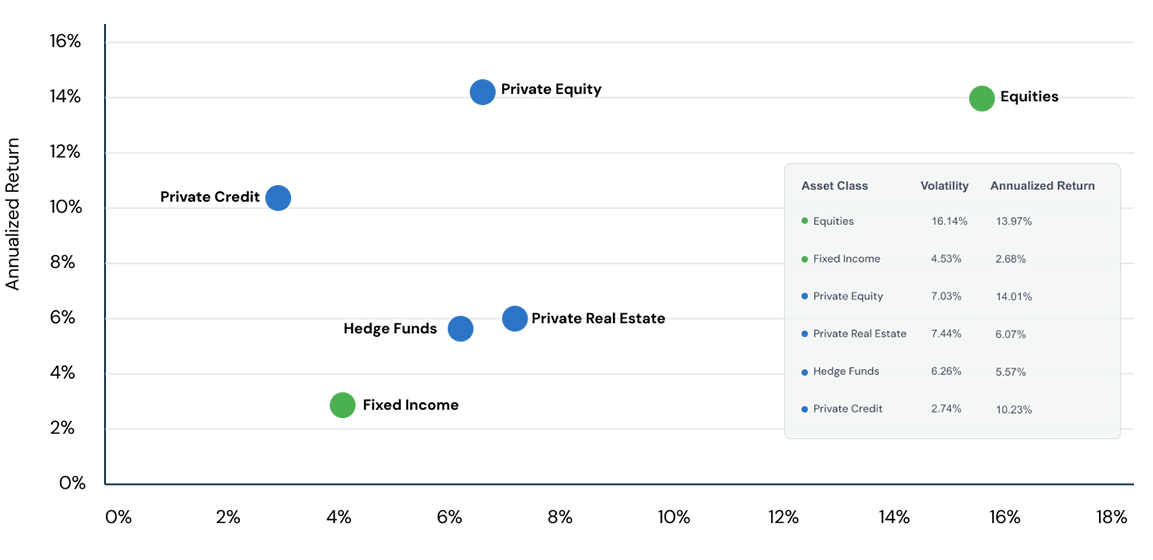
Source: Cliffwater, Evestment, Preqin. Time period from 1/1/2009–12/31/2023, most recent data available. Annualized Return and Standard Deviation are calculated based on quarterly price observations for all asset classes, and all the different asset classes are calculated using the same criteria Equities: S&P 500 Index; Fixed Income: Bloomberg U.S. Aggregate Bond Index; Private Real Estate: NCREIF Open-End Diversified Core Equity Fund Index (NFI-ODCE); Hedge Funds: HFN Aggregate Hedge Fund Index; Private Equity: Preqin Private Capital Quarterly Index; Private Credit: Cliffwater Direct Lending Index. Each index is calculated using its provider’s standardized, rules-based methodology. The S&P 500 Index measures large-cap U.S. equity performance, while the Bloomberg U.S. Aggregate Bond Index represents the investment-grade U.S. fixed-income market. The NFI-ODCE Index reflects core private real estate funds. The HFN Aggregate Hedge Fund Index represents an equal-weighted average of hedge funds and managed-futures strategies. The Preqin Private Capital Quarterly Index measures private equity portfolios, and the Cliffwater Direct Lending Index represents directly originated middle-market loans. Investors cannot invest directly in an index, and index performance does not always reflect management, incentive, brokerage, or fund-level expenses. These asset classes differ across a variety of factors. Investment objectives vary: Equities generally seek long-term capital growth; Fixed Income seeks income and capital preservation; Private Equity targets enhanced returns through active ownership and illiquidity premiums; Private Credit focuses on income generation through directly originated loans; Hedge Funds may pursue absolute-return, hedging, or arbitrage strategies; and Private Real Estate pursues income and appreciation from property ownership. Costs and expenses also differ: Private Equity, Hedge Funds, Private Credit, and Private Real Estate typically involve higher management and performance-based fees that are not present in Equities and Fixed Income. Liquidity profiles vary widely: Equities and Fixed Income offer daily liquidity, where Hedge Funds, Private Credit, Private Equity, and Private Real Estate carry illiquidity risk and varying redemption availability. None of these indices provide guarantees or insurance. Each asset class carries different levels of principal and return fluctuation, a measure of which is the Volatility shown on the graphic. Tax features differ: all asset classes may generate dividends or interest income subject to investor-level taxes, though Private Equity, Hedge Funds, Private Credit, and Private Real Estate may also produce complex tax reporting, including pass-through income, capital gains, depreciation effects, or unrelated business taxable income (UBTI). Volatility is represented by standard deviation, a statistical measure of return variability. Past performance is not a guarantee of future results. Financial professionals are responsible for evaluating investment risks independently and exercising their own judgment when determining whether investments or strategies are appropriate for their clients.
Our Podcast
We built IDA to be the antidote to the financial toxicity found in the world. We share insights that are straight-forward, evidence-based, and grounded in experience.
.png)
 Podcast : Financial Detox®
If you’ve saved well for retirement but haven’t planned for taxes after retirement, this is a conversation you don’t want to ignore.
.png) Podcast : Financial Detox®
Podcast : Financial Detox®
Most investors focus on performance, but far fewer focus on what they actually keep after taxes.